What is Space Age?
Very soon, Matt Comi and I will be releasing our new game, Space Age. So far, we’ve been fairly secretive about it. (Our trailer is definitely in the “teaser” category.) The reason for this coyness isn’t so much some possessiveness over our precious ideas; it’s that Space Age is a story-driven adventure game, so surprises are a part of not just its marketing, but its gameplay. If I were someone watching the development of this game from the outside, I’d prefer not to know much more about it.
That’s how I see it, anyway—but I may be mistaken, or atypical, or just a big dumb dummy. So, in this post, I’ll share some details about the game’s design and mechanics. No story spoilers, but some “design” spoilers, you could say.
Most people shouldn’t need to read this post. I recommend you just pick up the game and enjoy it on its own terms.
But if you’re really really curious, or you want to make sure you’ve had the “right idea” about Space Age so far, or you need a bit more encouragement to buy the game, then read on. As the man says in SNL’s fake commercial for That’s Not Yogurt, “I have a right to know what I just ate!”
Space Age is a “tactical adventure”. What does that mean? Well, it’s a graphic adventure game in the style of LucasArts’ and Sierra’s hits of the 1990s—games like The Secret of Monkey Island, The Dig, or Beneath a Steel Sky. However, the way you actually control the game is closer to what you might expect from a real-time strategy or a tactical/stealth game—something like Cannon Fodder or Commandos.
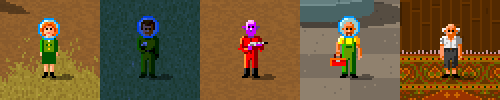
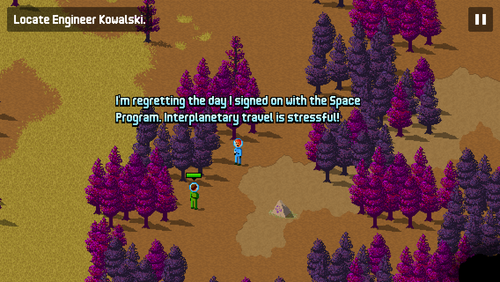
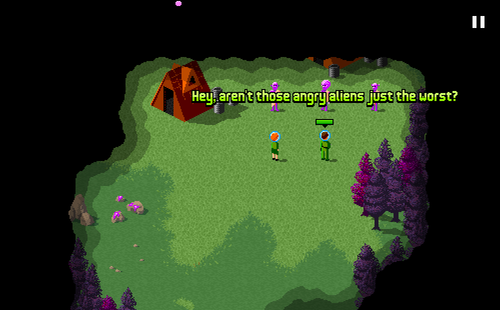
In Space Age, you guide your “team” through a series of top-down level maps, completing each level by accomplishing its specific mission goal (get from A to B, pick up X, convince Y). You can control one or more characters, pan the map, give one character a task to do while you control another. As you move, you uncover a “shroud”/”fog of war”, a dark cloud which prevents you from seeing areas you haven’t yet explored. You may remember this from Command & Conquer or Warcraft 2.
You can pick up items and place them in your inventory. You can then inspect them, use them, or combine them with other items. There’s lots of dialogue—you can talk to other characters, overhear conversations, read signs, etc. There is no voice acting in Space Age; I’ve always thought human voices don’t fit pixel-art characters. There is however, a whole lot of music. It’s not chiptune, or minimalist, or even electronic—it’s everything else, cinematic and rich and multi-genre. I absolutely adore the work Cabel has done here.

Timing “how long it takes to finish a game” is hard, but I’ll tell you this: the first tester to finish the complete game took about eight hours of actual play (and about three days total.) I don’t think you could speed-run it in under an hour. There are puzzles in Space Age that will probably get you “stuck”, the way LucasArts’ devious games do (Sam & Max!!!) so you may not finish it in one sitting. There are reaction-time challenges that’ll have you failing over and over; don’t worry, the game lets you retry quickly. And there are achievements you’ll want to replay the game for. They reward exploring, curiosity, and stealthiness.
Describing the game this way fails to convey all the things I personally like about it. This post is, after all, a kind of biopsy. So what is it that I hope you’ll really like about Space Age? Setting modesty aside for a moment, I’ll wince through hearing myself type that I find Space Age charming, surprising, memorable, funny and fun. Phew.
Oh, and how soon is that “very soon” I teased you with? Space Age will be released on iOS this month, November 2014.
I promise.